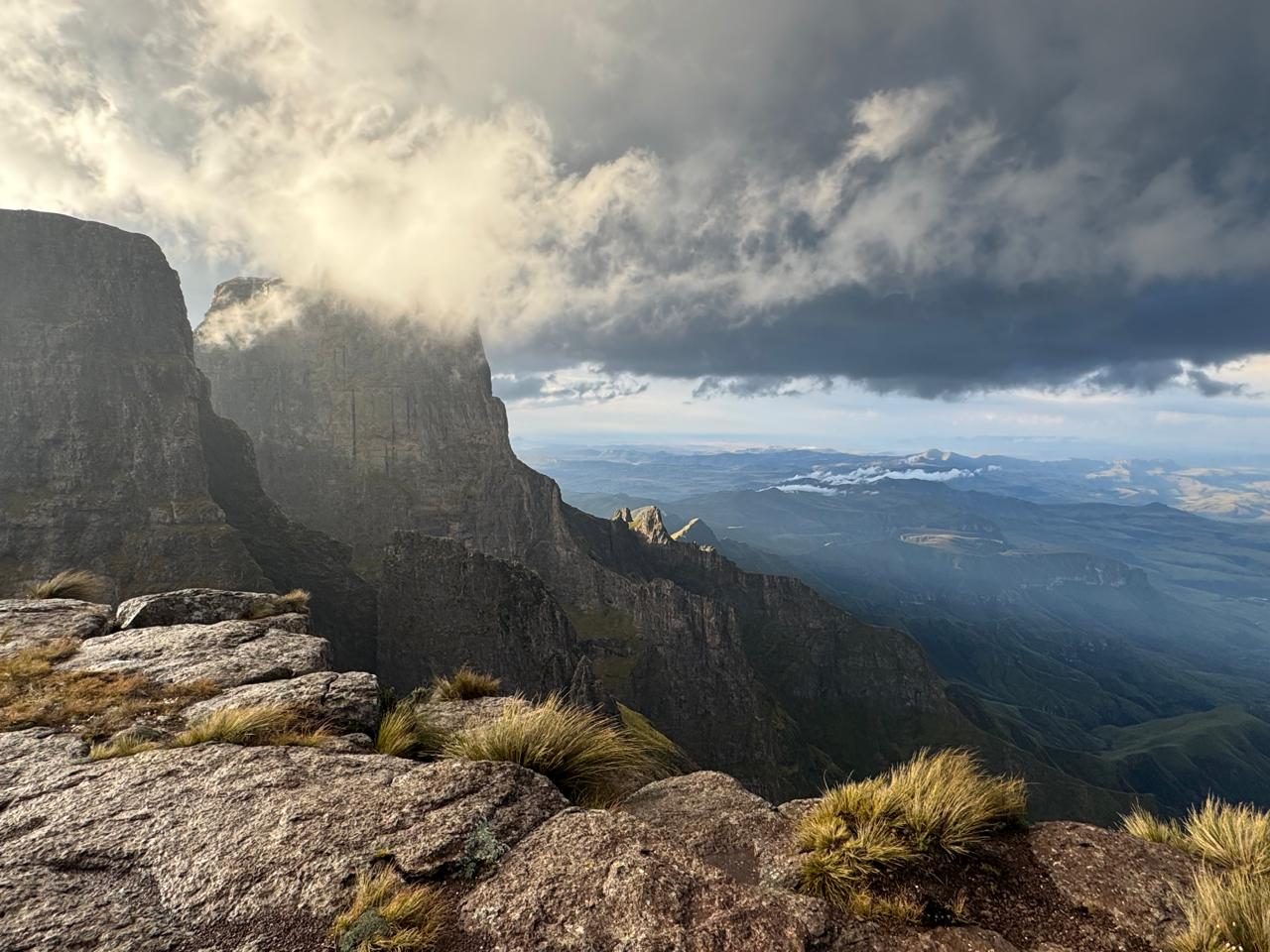
Storm light over the edge of the escarpment, with the KwaZulu-Natal foothills far below
31 March to 5 April 2027

Northern Berg Traverse

Sentinel to Cathedral Peak along the roof of the Drakensberg. Five days on the escarpment, everything on our backs.

63 km · four nights at about 3,000 m · twelve people
Northern Berg, April 2026

The Japanese call it misogi: one challenge a year hard enough to change what you think you're capable of. This is ours.Northern Berg Traverse, 2027

Five days along the top of the Northern Drakensberg, from the Sentinel to Cathedral Peak. We climb the chain ladders onto the escarpment on the first morning and don't come down until the last afternoon. In between are four nights camped at around 3,000 m, on the edge of the Amphitheatre, the Mnweni and the Rockeries, with the Lesotho highlands behind us and KwaZulu-Natal a kilometre below.

It is self-supported: there are no porters, huts or vehicles. We carry our tents, our food and our warm kit, and the packs are heaviest on the first two days. Most of the route has no path. And the last day comes down 1,700 m of Mlambonja Pass to a hot shower, a celebration dinner and a bed at Cathedral Peak Hotel.

Open to the whole family. Twelve places.

63 kmSentinel car park to Cathedral Peak Hotel
5hiking days, 3.5 to 10 hours each
2,330 mup, and 3,360 m down
1,700 mof descent on Day 5, down Mlambonja Pass
What to expect

What a day on top looks like.

The walking

Six to eight hours a day on most days, on grass, rock and tussock, often off any path. Nothing is technical apart from the ladders on Day 1. The challenge is the weight on your back and doing it again tomorrow.

The camps

Wild camps by water, close to the edge. We cook together, eat early and are in our sleeping bags not long after dark. Nights are close to freezing in early April. The stars are something else.

The finish

Day 5 is the big one: over the Twins and down Mlambonja Pass, with the Bell, the Horns and Cathedral Peak above us. Then showers, a long dinner and a proper bed at Cathedral Peak Hotel.

Northern Berg, April 2026

What you'll see up there.

From the traverse in April 2026. Tap a photo to enlarge.

Schematic, not for navigation. Tap to enlarge.
The route

Along the border, on the edge.

We leave the cars at Cathedral Peak Hotel, the finish, and take a shuttle round to the Sentinel car park above Witsieshoek. From there the route climbs onto the Amphitheatre and heads south along the escarpment, on or just inside the Lesotho border, for four days.

It swings in and out around the heads of the great valleys: the Tugela, the Mnweni and the Mlambonja. On Day 5 it drops off the edge down Mlambonja Pass and walks out to the hotel, back to the cars.

The route and timings come from my own GPS tracks of this traverse with full packs.

Itinerary

Day by day.

CAMP 1CAMP 2CAMP 3CAMP 4SENTINEL 2,540 MHOTEL 1,480 MMLAMBONJADAY 1DAY 2DAY 3DAY 4DAY 5
Camp heights recorded on the route. The line between camps is indicative.
Day 1
Wed 31 March
  • 6.8 km
  • +580 m / −140 m
  • About 3.5 hours walking
  • Camp 2,985 m

Up the ladders

Sentinel car park to the top of Tugela Falls

We meet at Cathedral Peak Hotel at 8am, leave the cars and take the shuttle round to the Sentinel car park, about two and a half hours. Expect to start walking late morning.

The path zigzags up past the Witches and contours under the Sentinel to the chain ladders, two near-vertical sections that put you on the escarpment. Then it is a short walk across the plateau to the Tugela.

Camp at the top of Tugela Falls, one of the highest waterfalls in the world. Sundowners on the lip of the Amphitheatre, with Royal Natal a kilometre below. Given the space in our packs, sadly, they'll be hot chocolate.
Day 2
Thu 1 April
  • 14.2 km
  • +550 m / −540 m
  • 6 to 7 hours
  • Camp 2,992 m

Along the edge

Tugela Falls to Icidi

An optional early detour to the summit of Mont-aux-Sources, 3,282 m, where the Tugela starts. Then south along the edge, past the Ifidi and Icidi buttresses, looking down into Royal Natal and the Mnweni.

There is no path for much of this. We walk the grassland on top of the escarpment, choosing the line as we go. Expect to meet Basotho herders and their dogs.

Day 3
Fri 2 April
  • 15.8 km
  • +430 m / −500 m
  • 7 to 7.5 hours
  • Camp 2,917 m

The Mnweni

Around the Mnweni Cutback to the Rockeries

The longest day by distance. The route swings west into Lesotho around the head of the Mnweni Cutback, with the Mnweni Needles and Pinnacles standing off the edge, then comes back out to the Rockeries.

Possibly the best stretch of the whole escarpment.

Day 4
Sat 3 April
  • 11.0 km
  • +460 m / −480 m
  • About 5 hours
  • Camp 2,891 m

The Fangs

Mponjwane and the Fangs to the Saddle

Past Mponjwane and the Fangs to the Saddle. A shorter day, which leaves the afternoon to rest the legs, explore the edge and watch for bearded vultures.

We go to bed early, because tomorrow is the big one.

Day 5
Sun 4 April
  • 15.3 km
  • +310 m / −1,700 m
  • 9 to 10 hours
  • Bed at the hotel

Mlambonja

The Twins, then down Mlambonja Pass to Cathedral Peak Hotel

Along the top to the Twins, then the long descent of Mlambonja Pass, with the Cathedral range (the Bell, the Horns and Cathedral Peak) above us all the way down.

Seventeen hundred metres of descent in a day, on a loose path, at the end of four days with a pack. This is the day the training is for. Celebration dinner, drinks and a bed at Cathedral Peak Hotel.

Day 6
Mon 5 April

Home

Breakfast, then home, the golf course or the pool

Leave at 6am and you are at your desk in Hilton by 8am. Those without desks to get to can lie in, play a round at Cathedral Peak Golf Club or spend the morning recovering at the pool, and be home after lunch.

Weather and the plan

The days above are the plan, and the mountain gets a vote. If mist or storms close in, we wait, shorten or take a pass down early. If Day 5 runs long, we camp below Mlambonja Pass and walk out to the hotel on Monday morning. Keep Monday 5 April flexible, just in case, and be prepared to call in sick.

Training

Train your legs to carry weight downhill.

A fit person without a pack will find this hard. A fit person who has trained with a pack will enjoy it. The plan runs from now to Easter. The aim is simple: by mid-March you can walk 7 to 8 hours on hills with about 14 kg on your back, and do it again the next day.

The muscle that decides the trip is the front of the thigh, working as a brake on the way down. Day 5 is 1,700 m of descent. Train for it.

Now to Christmas
Base

Get moving.

  • Walk or hike three times a week, at least 45 minutes each.
  • One longer outing at the weekend, 2 to 3 hours, on hills.
  • Start the strength routine twice a week.
  • Buy or borrow boots now, and start wearing them.
4 to 31 January
Build

Add the pack.

  • Two midweek sessions of 45 to 60 minutes on hills or stairs.
  • Weekend hike of 3 to 4 hours carrying 8 kg.
  • Strength twice a week.
  • Boots on for every hike from here.
1 to 28 February
Load

Heavier and longer.

  • Weekend hike of 5 to 6 hours carrying 12 kg, with at least 800 m of climbing and the same coming down.
  • Once this month, hike two days in a row.
  • Strength twice a week, adding the slow step-downs.
  • Walk the descents, don't jog them. Downhill with weight is the skill.
1 to 21 March
Specific

Full kit, full day.

  • One shakedown overnight with the pack you will carry: tent, stove, food, the lot.
  • One 7 to 8 hour day with 14 kg or more and a big descent.
  • Fix anything that rubs, leaks or hurts now, not on Day 2.
  • Strength once or twice a week.
22 to 30 March
Taper

Rest and pack.

  • Easter week. Short, easy walks only.
  • Pack, weigh and repack.
  • Sleep, eat well and arrive fresh.

Strength, twice a week

Step-upsOnto a knee-height step or bench, with a loaded pack. 3 sets of 12 each leg.
Slow step-downsOff the same step, taking three seconds to lower. This is the Mlambonja exercise. 3 sets of 10 each leg.
Split squatsBack foot raised on a bench. 3 sets of 10 each leg.
Calf raisesOn a step edge, single leg when you can. 3 sets of 15.
Side planks and planks30 to 60 seconds each. A strong trunk carries a pack.
Single-leg balanceEyes closed, 30 seconds each side. Ankles that survive four days of tussock.

Are you ready? Three tests by mid-March

A 6 to 7 hour hill day with 14 kg, finishing with a long descent, and you're stiff the next morning rather than broken.
Two hard hiking days back to back with a full pack.
One night out in your own tent and sleeping bag, cooking on your own stove, with everything you plan to carry.

Stairs, repeats up Inhlosane, or a treadmill at full incline all count. A weighted vest makes midweek sessions easy to fit in, but do the weekend hikes with the pack you'll carry, because that's where fit problems show up. Walking with weight beats any gym session.

Kit

What goes in the pack.

Everything below comes with us for five days. Good kit makes the cold nights comfortable and the heavy days lighter. A full checklist comes closer to the time; this is enough to start borrowing and buying.

CarryBackpack, 55 to 65 litres, fitted to you. Pack liner or heavy-duty bin bags. Trekking poles, which I strongly recommend for Mlambonja.
SleepTent, ideally shared between two. Sleeping bag comfortable to −5°C. Insulated sleeping mat. Nights on top in early April are near freezing.
WearBroken-in boots with ankle support, ideally. If not, good trail shoes with a firm sole that you've already hiked in with a full pack. Hiking socks, two or three pairs. Quick-dry shirt and shorts or trousers. Sun hat and sunglasses.
Warm and dryWaterproof jacket and overtrousers, proper ones. Fleece or light down jacket. Thermal top and leggings for camp. Beanie and gloves.
Cook and drinkStove and gas, shared. Mug, spoon and a pot. 2 litres of water capacity and purification tablets or a filter.
OddsHeadlamp. Sunscreen and lip balm. Personal first aid and blister kit. Toilet trowel, paper and a bag to carry it out. Passport, in a zip bag. Most of the route runs along or inside the Lesotho border.

Target pack weight on Day 1, with food and water: 13 to 16 kg. Shared kit goes to whoever carries it best.

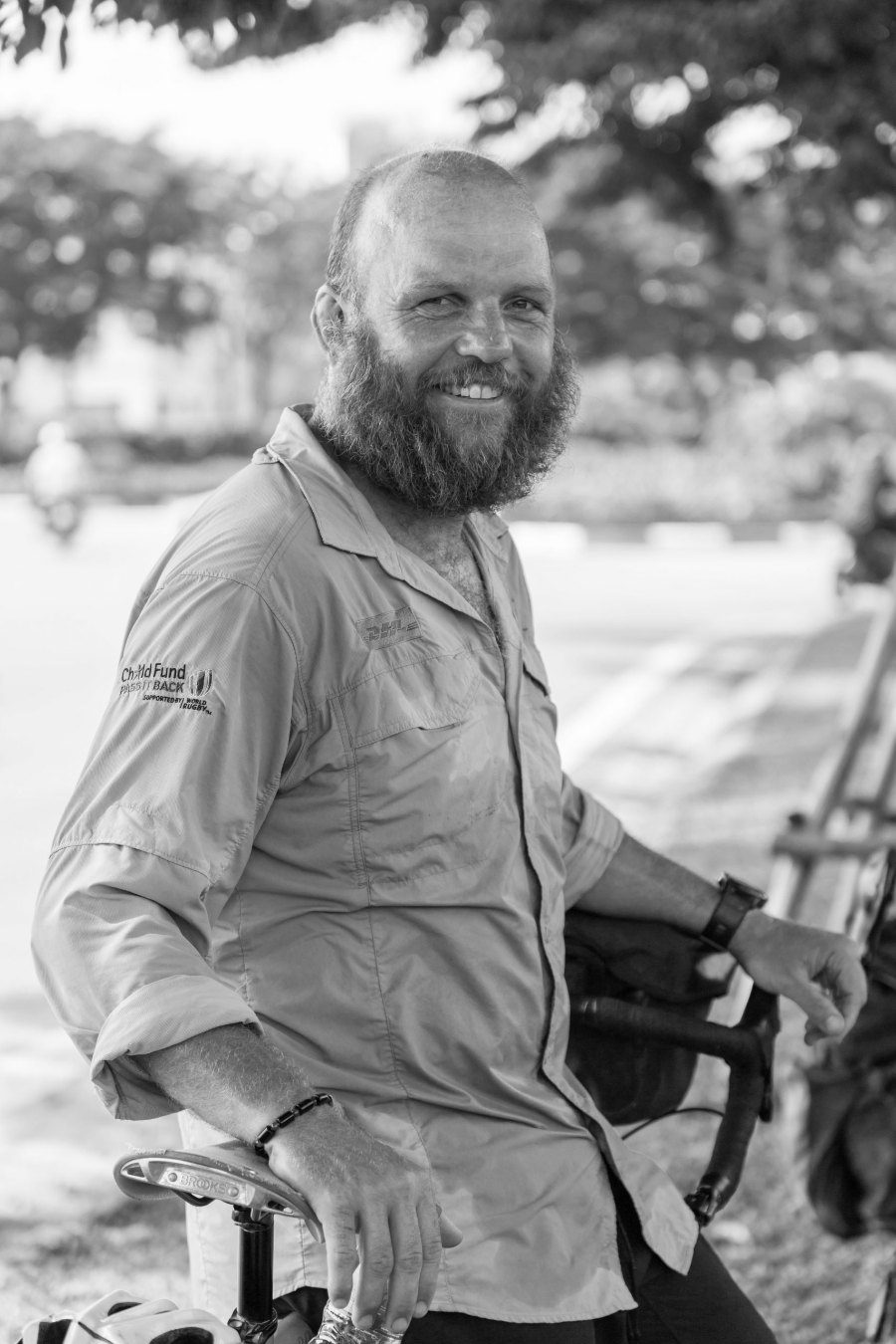
Ron Rutland leaning on his bicycle, black and white
Who's leading

Ron Rutland

I've cycled about 95,000 km through 120 countries on six continents, crossed Mongolia three times on foot and by motorbike, and walked this traverse with a full pack. More about me below.

I live in Nottingham Road, an hour from the start. I'll plan the trip, sort the logistics and lead every day on the mountain.

Unlikely Expeditions runs hard trips for people who don't think of themselves as adventurers. The unlikely one is always you.

Questions

What people ask.

Who is Ron Rutland?

I'm a South African adventurer and speaker, based in Nottingham Road in the KZN Midlands. I started out in finance, spending many years in the UK and Asia, then started and ran an events business in Cape Town that hosts the Cape Town Tens every year. Most recently I spent just over two years as Director of the Old Boys' Club at Michaelhouse, before deciding I needed to spend more time outdoors, sharing the best places I've found with other people.

From 2013 to 2015 I spent 27 months cycling some 42,000 km from Cape Town to Brighton, through (almost) every country in Africa, for the 2015 Rugby World Cup. In 2017 came The Longest Hole in Mongolia, which became a film of the same name. In 2019, with a replaced hip, I cycled 20,093 km from London to Tokyo with James Owens, and that ride became the film Everything In Between. In 2022 Adam Nunn and I spent 20 months cycling from Tokyo to Paris via South America. Three long rides, 120 countries, about 95,000 km.

Before the Africa ride I was a fat former prop with no adventure experience at all. I've since crossed Mongolia three times, on foot and by motorbike, and walked this traverse with full packs. I know where it bites.

How fit do I need to be?

Fit enough to walk 6 to 8 hours on rough ground with 12 to 15 kg on your back, and get up and do it again the next day, four days running. Then come down 1,700 m on the fifth. Nothing on the route needs technical skill. It needs legs, and a head that keeps going when they're tired.

If you follow the training plan from January, you'll be ready. If you're not sure where you stand, ask me.

Can the kids come?

Yes. This trip is for the whole family. Teenagers who play sport will cope well. Get them training with a loaded pack in the new year, and make sure their sleeping kit is warm enough for nights near freezing. If you're thinking of bringing anyone under 14, talk to me first.

What are the chain ladders like?

Two near-vertical steel ladders, one after the other, bolted to the rock. They're solid and well used, and people with no climbing experience go up them every weekend. If heights bother you, tell me beforehand and we'll get you up calmly. There's a gully route beside them if anyone can't face the ladders.

Where does the water come from?

Streams on top of the escarpment. In late summer there's usually plenty, and we camp by water each night. Carry two litres between sources and treat everything you drink, with tablets or a filter. The livestock up there use the same streams.

What will the weather do?

Early April is the start of autumn and one of the best times to be on top. Days are often clear and mild. Nights are near freezing, mist can come in fast, and afternoon thunderstorms are still possible. Lightning is the main hazard on the escarpment, so we start early and plan to be off the high points by mid-afternoon.

Pack for cold and wet, even if the forecast is perfect.

What if someone can't go on?

Every day has a way off. The Mnweni passes on Days 2 and 3 are the obvious routes down, and I'll brief the bail-out options each morning. We carry a satellite communicator and group first aid. Cellphone signal on top is patchy at best, so don't count on it.

If Day 5 runs slow, or the weather turns, we camp below Mlambonja Pass at about 2,050 m and walk out to the hotel the next morning. Keep Monday morning flexible, just in case, and be prepared to call in sick.

What does it cost, and what's included?

I'll finalise costings before mid-December. The plan is that it covers the shuttle from Cathedral Peak to the Sentinel car park, park and hiking fees, food on the mountain, and the night, dinner and breakfast at Cathedral Peak Hotel. The confirmed list comes with the price. You bring your own kit, and if you're short of something, ask: between us we can usually cover it.

How many people?

Twelve, possibly up to fourteen. Ezemvelo's recommended limit is twelve in one party in the wilderness area, but with permission we can increase it slightly. Either way, it's a good size for camp.

Do I need insurance?

Mountain rescue in the Berg is free: the Mountain Club runs it with volunteers, backed by Air Force and police helicopters. The ambulance, hospital and any private helicopter afterwards are not. Make sure your medical aid or hospital plan covers emergency transport and private hospital treatment, and carry your medical aid details with you. Visitors from overseas need travel insurance that includes evacuation.

What about toilets?

There aren't any. We follow leave-no-trace rules: dig a hole well away from water and camp, and carry out the paper. Bring a trowel and a sealable bag.

Have a question that isn't here? WhatsApp or call me on 072 636 3300 and I'll add the answer.

Start training now.

Sentinel to Cathedral Peak, 31 March to 5 April 2027. Twelve of us, and one hard thing for the year. We'll earn every drink at Cathedral Peak.

072 636 3300 · ron@ronrutland.com